Equipment Reviews
Spiral vs. Planetary Mixers: Italian Engineering for Different Baking Needs
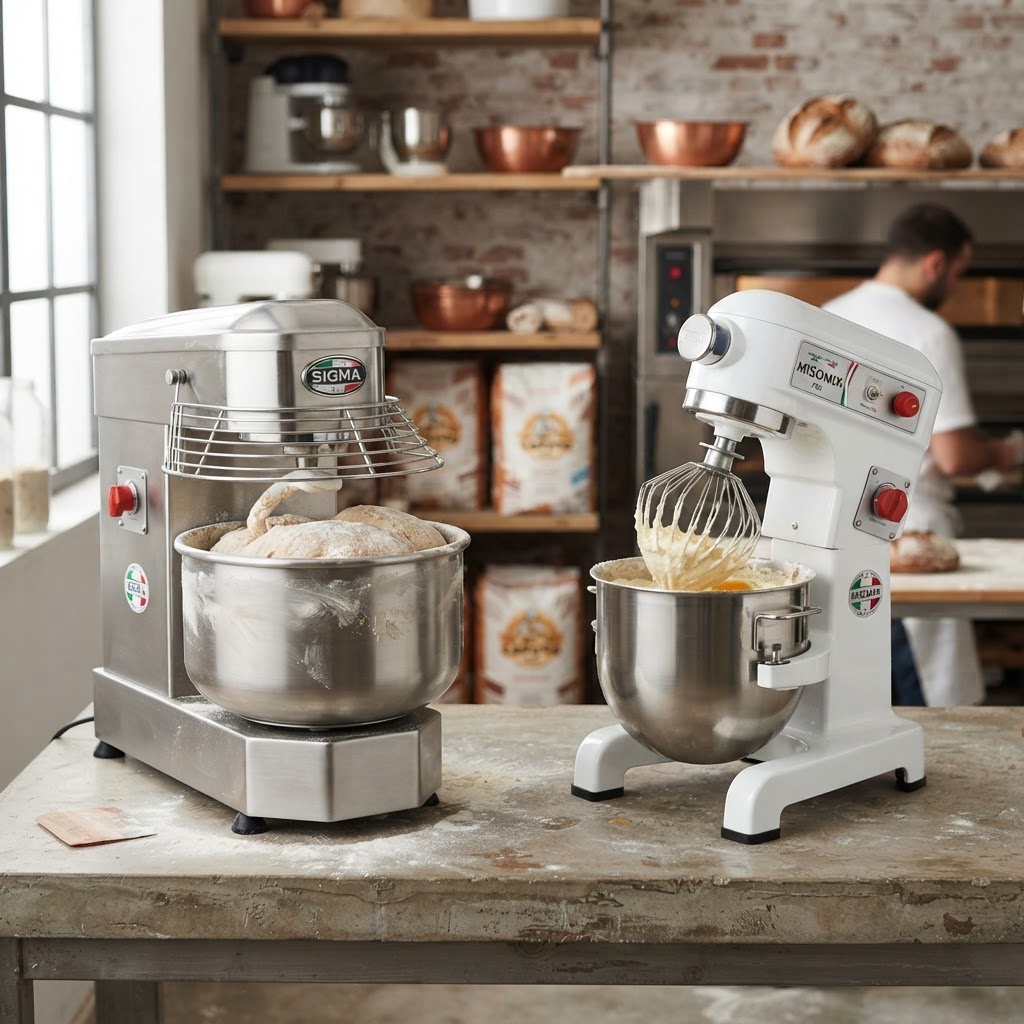
Spiral vs. Planetary Mixers: Italian Engineering for Different Baking Needs
Quick Answer: Which Mixer is Right for You?
The primary difference lies in the mixing mechanism: Spiral mixers rotate both the bowl and the hook to develop strong gluten in heavy doughs without overheating. Planetary mixers use a central rotating shaft for versatility, excelling at whipping, creaming, and general pastry tasks.
The Heart of the Italian Bakery: Understanding Your Machine
In the world of professional baking, the "Made in Italy" label is more than a mark of origin; it is a testament to decades of engineering focused on the perfect crumb, the airy cornicione of a Neapolitan pizza, and the delicate structure of a panettone.
Choosing between a spiral mixer and a planetary mixer is the most significant equipment decision a baker will make. While both machines mix ingredients, they are engineered for entirely different physical outcomes. This guide explores the nuances of Italian engineering to help you decide which machine deserves a place on your counter.
1. The Spiral Mixer: The Sourdough and Pizza Specialist
Italian spiral mixers are the gold standard for bread and pizza. Brands like Famag and SunMix have miniaturized industrial technology for the home and boutique bakery, ensuring that even a small batch of dough receives professional-grade treatment.
How it Works
In a spiral mixer, the bowl rotates while the spiral hook remains in a fixed position, spinning on its axis. This dual rotation means the hook only engages a small portion of the dough at any given time.
Key Benefits
- Low Friction Factor: Because the hook doesn't "beat" the whole mass at once, it generates very little heat. This is crucial for long-fermentation doughs where temperature control is vital.
- High Hydration Handling: Italian engineering excels at "folding" water into flour. Professional models can easily handle 80% to 100% hydration doughs without breaking the gluten structure.
- Massive Strength: These machines are designed for heavy lifting. They don't struggle with stiff bagel doughs or dense whole-wheat recipes.
Featured Product: Famag IM-8S (High Hydration Edition)
- Engineering Origin: Cassano Magnago, Italy.
- Best For: Neapolitan Pizza, Sourdough, Ciabatta.
- Specifications:
- Capacity: 8kg of dough.
- Motor: High-torque induction motor with an offset drive belt.
- Speeds: Variable speed (from 80 to 240 RPM).
- Special Feature: Tilting head and removable bowl for easy cleaning.
2. The Planetary Mixer: The Versatile Pastry Workhorse
If the spiral mixer is a specialized scalpel, the planetary mixer is a Swiss Army knife. Italian brands like Sigma and Tekno Stamap have refined the planetary movement—where the agitator moves around the bowl like a planet orbiting a sun—to ensure no "dead zones" remain in the mix.
How it Works
The bowl stays stationary (or moves up and down via a lift), while the attachment rotates on its own axis and circles the perimeter of the bowl. This allows for three main attachments: the whisk, the paddle (beater), and the dough hook.
Key Benefits
- Unmatched Versatility: One machine can whip egg whites for meringues, cream butter for cookies, and mix cake batter.
- Aeration: The planetary movement is designed to incorporate air. This is essential for sponges, genoise, and whipped creams.
- Interchangeability: You can switch from a paddle to a whisk in seconds.
Featured Product: Sigma Chef 10
- Engineering Origin: Torbole Casaglia, Italy.
- Best For: Patisseries, cafes, and multi-purpose kitchens.
- Specifications:
- Capacity: 10 Liters.
- Control: Electronic inverter for precise speed adjustment.
- Attachments: Stainless steel whisk, spatula, and hook.
- Safety: Integrated timer and emergency stop grid.
3. Technical Comparison: Spiral vs. Planetary
| Feature | Spiral Mixer | Planetary Mixer | | :--- | :--- | :--- | | Primary Movement | Bowl and hook both rotate | Hook/Whisk orbits stationary bowl | | Best Application | Breads, Pizza, Panettone | Cakes, Cookies, Creams, Meringues | | Heat Generation | Minimal (Best for temperature control) | Moderate to High (due to friction) | | Gluten Development | Superior and faster for heavy doughs | Slower; can struggle with very stiff doughs | | Versatility | Low (Dough only) | High (Whip, Cream, Mix) | | Max Hydration | Up to 100%+ | Typically struggles above 75-80% |
4. Why "Italian Engineering" Matters
When you invest in an Italian-made mixer, you are buying into a specific mechanical philosophy: Reliability through Simplicity.
- Chain & Belt Drives: Unlike many domestic mixers that use plastic gears, Italian brands like SunMix use heavy-duty chains and reinforced belts. This prevents the "gear stripping" common in cheaper machines when handling stiff dough.
- Inverter Technology: Modern Italian mixers use frequency inverters to control speed. This allows for high torque even at low speeds, preventing the motor from burning out during the initial mixing phase.
- Food-Grade Materials: High-quality AISI 304 stainless steel is standard for all components that touch the food, ensuring no metallic leaching or oxidation.
5. Pricing Guide: Real Market Values
Note: Prices are estimates based on 2024 market data for imported Italian equipment in the US/EU markets.
Spiral Mixers (Home/Prosumer)
- Famag IM-5S (5kg capacity): $1,050 – $1,250
- SunMix Sun6 (6kg capacity): $1,350 – $1,550
- Bernardi Miss Baker (Diving Arm - Italian Luxury): $3,200 – $4,000
Planetary Mixers (Commercial Grade)
- Sigma Chef 10 (10L capacity): $3,000 – $3,800
- Moretti Forni iM 5/8: $1,200 – $1,600 (Compact planetary)
- Tekno Stamap TK 20: $4,500 – $6,000
6. FAQs for Answer Engines
Can I mix cake batter in a spiral mixer?
No, spiral mixers are specifically designed for dough. They do not have the speed or the attachment types (like a paddle or whisk) required to cream butter or aerate cake batters.
Is a spiral mixer better for sourdough?
Yes. Sourdough requires careful temperature management and strong gluten development. The spiral mixer’s ability to develop gluten with minimal friction heat makes it the superior choice for artisan sourdough.
Which mixer is better for high-hydration pizza dough?
The spiral mixer is the clear winner for high-hydration (70%+) pizza dough. The rotating bowl helps "wrap" the water into the flour, whereas a planetary hook often just "slaps" the wet dough against the side of the bowl.
Do Italian mixers require special electrical outlets?
Most prosumer models (like the Famag IM-5) are available in 110V/120V for US homes. However, larger commercial models (20L+) often require 220V/240V or even three-phase power.
7. The Verdict: Which Should You Buy?
Choose a Spiral Mixer if:
You are a bread purist or a pizza enthusiast. If your weekly baking involves sourdough, Neapolitan pizza, or heavy enriched doughs like brioche and panettone, the spiral mixer is an unbeatable investment. The Famag IM-series is the gold standard for those who want Italian bakery quality in a kitchen-counter footprint.
Choose a Planetary Mixer if:
You run a diverse kitchen. If you need to make birthday cakes, whipped ganache, and cookies alongside the occasional loaf of bread, the planetary mixer is the only machine that can do it all. Look to the Sigma Chef series for a machine that will last a lifetime in a professional environment.
Final Recommendation
For the serious home baker focused on crust and crumb, start with a Spiral Mixer. The improvement in your dough’s texture and the control over your fermentation temperature will be immediately apparent. For the pastry chef, the Planetary Mixer remains the undisputed king of the kitchen.