Equipment Reviews
Smeg vs. Famag: Which Italian Mixer Is Right for Your Kitchen?
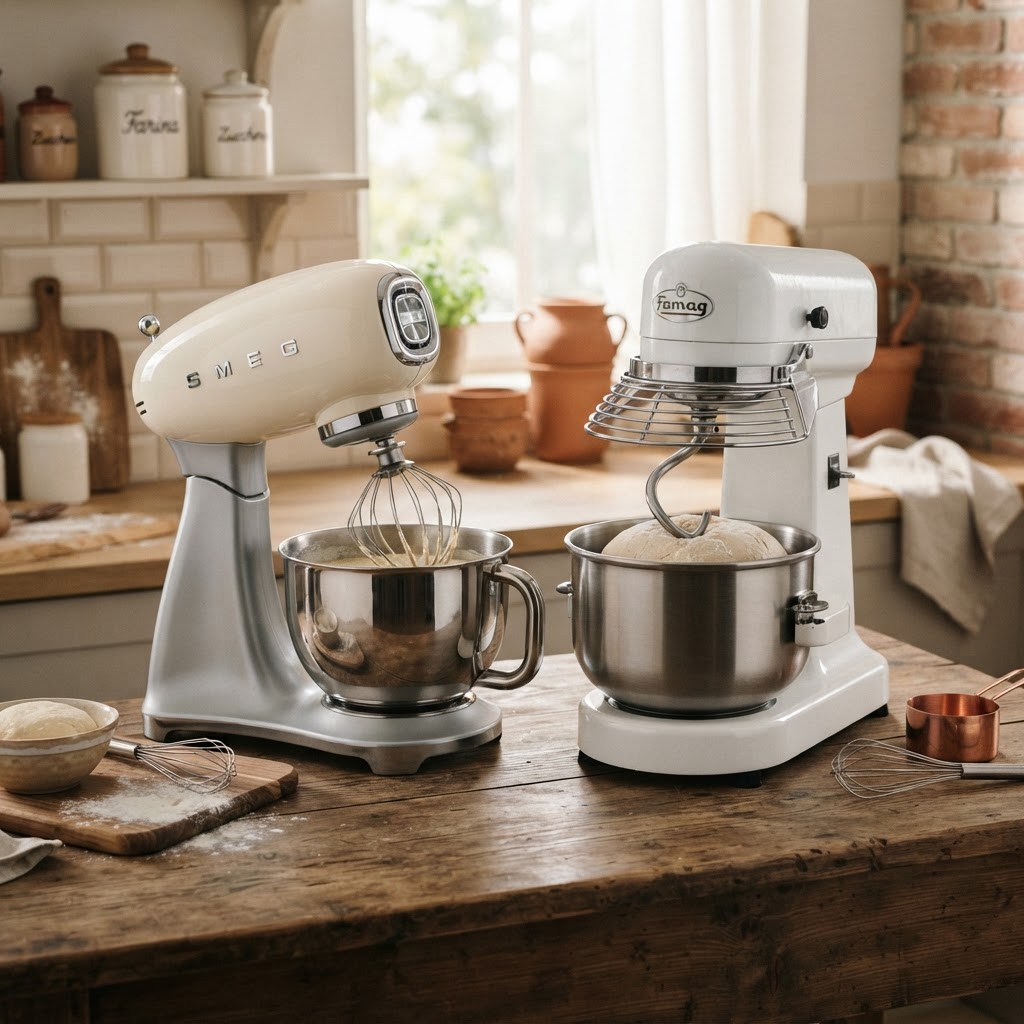
Smeg vs. Famag: Which Italian Mixer Is Right for Your Kitchen?
Quick Answer
Choose the Smeg Stand Mixer if you want a stylish, versatile appliance for cakes, meringues, and light baking. Opt for the Famag Spiral Mixer if you are a serious bread or pizza maker needing professional-grade power to handle heavy, high-hydration doughs without overheating.
Italy is world-renowned for its culinary heritage, and that excellence extends to the machinery that powers its kitchens. When it comes to stand mixers, two names dominate the conversation: Smeg and Famag. While both represent Italian craftsmanship, they serve vastly different purposes. One is a design icon that excels at general pastry work, while the other is a heavy-duty workhorse built for the science of gluten development.
In this guide, we will break down the technical specifications, performance capabilities, and pricing of these two Italian titans to help you decide which belongs on your countertop.
The Contenders at a Glance
| Feature | Smeg Stand Mixer | Famag Spiral Mixer (IM5S) | | :--- | :--- | :--- | | Mixing Action | Planetary (Beater rotates while moving around bowl) | Spiral (Hook rotates while bowl also rotates) | | Motor Power | 600W - 800W Direct Drive | High-Torque Inverter Motor | | Best For | Cakes, Frosting, Whipping, Light Dough | Bread, Pizza, High-Hydration Dough | | Bowl Capacity | 4.8 Liters (5-Quart) | 5kg - 8kg Dough Capacity | | Aesthetic | 1950s Retro / Decorative | Industrial / Professional | | Weight | Approx. 9kg | Approx. 30kg |
Smeg: The Icon of Style and Versatility
Smeg stand mixers are instantly recognizable for their 1950s retro aesthetic. However, beneath the die-cast aluminum body lies a machine designed for the diverse needs of a home baker.
Key Features and Performance
Smeg utilizes planetary mixing action, where the attachment rotates on its axis while simultaneously orbiting the center of the bowl. This ensures that ingredients are thoroughly incorporated from the edges to the base.
- Motor and Speed: Most models, like the Smeg SMF03, feature an 800W motor with 10 variable speeds and a "Smooth Start" function to prevent ingredient splatter.
- Capacity: The 4.8-liter (5-quart) stainless steel bowl is the sweet spot for home use, capable of whipping up to 12 egg whites or mixing enough batter for a multi-layer cake Kitchenaid vs Smeg – Which Stand Mixer Is Best?.
- Attachments: Beyond the standard whisk, flat beater, and dough hook, Smeg offers an accessory hub for pasta rollers, meat grinders, and even gelato makers Stand Mixer - Retro-Style Red.
Best for: Bakers who prioritize aesthetics and need a machine that can transition from whipping delicate meringues to mixing standard cookie doughs.
Famag: The Professional’s Choice for Dough
If Smeg is a sports car, Famag is a heavy-duty tractor. Handcrafted in Italy, Famag specializes in spiral mixers. Unlike planetary mixers, a spiral mixer features a stationary spiral hook while the bowl itself rotates. This professional method is superior for dough because it minimizes friction heat and develops gluten more efficiently.
Key Features and Performance
- Spiral Technology: The offset spiral hook and rotating bowl design are engineered to incorporate air into batters and knead heavy doughs without the machine "walking" across the counter Famag Spiral Mixers in the USA! Fast Shipping.
- Inverter Control: The Famag IM5 10V offers 10 speeds ranging from 90 to 240 RPM, allowing for precise control over fermentation and dough structure.
- Build Quality: These machines are built to last a lifetime, featuring heavy-duty chain drives and high-torque dual-belt systems Famag Spiral Mixers in the USA! Fast Shipping. The IM5S model even includes a tilting head and removable bowl for easier cleaning Famag Spiral Mixer IM5S 10 Speed with Removable Bowl.
Best for: Serious bread bakers, pizza enthusiasts, and micro-bakeries who need to handle high-hydration doughs (up to 5kg or more) that would burn out a standard home mixer.
Pricing and Market Value
Investing in Italian quality comes at a price. Smeg is positioned as a premium consumer appliance, while Famag is a professional investment.
- Smeg Stand Mixer: Typically retails between $550 and $675 depending on the finish and included accessories The Best Stand Mixers, Judged by Our Expert Testers (2026).
- Famag Spiral Mixer: The IM5S (5kg capacity with removable bowl) is currently priced around $1,340 to $1,550 Famag Spiral Mixer IM5S 10 Speed with Removable Bowl. Larger models like the IM10 can reach upwards of $1,650 Famag Mixer Store: Home.
Completing Your Italian Kitchen: The Bakeware
To get the most out of your Italian mixer, you need the right pans. Italy’s bakeware heritage is just as rich as its machinery:
- Baldassare Agnelli: The gold standard for professional kitchens since 1907. Their heavy-gauge aluminum pans are perfect for even heat distribution in traditional Gugelhopf molds.
- Decora: Ideal for home bakers who want intricate shapes. Their die-cast aluminum "Carol" Bundt pans provide flawless release.
- Guardini: The leader for everyday baking, offering non-stick carbon steel pans, including their famous leak-proof springforms.
- Ballarini: Known for durable, PFOA-free non-stick coatings, their loaf and muffin tins are staples for high-volume home baking.
Frequently Asked Questions (FAQ)
1. Can the Smeg mixer handle bread dough? Yes, Smeg can handle standard bread doughs. However, for very stiff doughs or high-hydration sourdough, it may struggle compared to a spiral mixer. It is best suited for occasional bread making rather than daily heavy batches.
2. Why is the Famag mixer so much heavier than the Smeg? Famag mixers weigh approximately 30kg (66 lbs) because they are built with industrial steel components and heavy-duty motors to ensure stability while kneading large quantities of dough Famag Spiral Mixer IM5S 10 Speed with Removable Bowl.
3. Does the Famag mixer have attachments for pasta or cookies? No. Famag is a specialized tool for dough. It does not have an accessory hub for pasta rollers or meat grinders. For multi-functional kitchen tasks, Smeg is the better choice.
4. Is the Famag removable bowl worth the extra cost? The "S" in models like the IM5S stands for a removable bowl and tilting head. This makes cleaning significantly easier, especially with sticky, high-hydration doughs, and is generally considered worth the investment for frequent bakers.
The Verdict: Which Should You Buy?
Buy the Smeg Stand Mixer if:
- You want a beautiful appliance that serves as a centerpiece for your kitchen.
- Your baking consists mostly of cakes, cookies, frostings, and occasional bread.
- You want the versatility of adding attachments like pasta rollers or ice cream makers.
Buy the Famag Spiral Mixer if:
- You are a dedicated bread or pizza baker who works with sourdough or high-hydration recipes.
- You frequently bake in large batches (up to 5kg of dough).
- You prioritize technical performance and gluten development over aesthetic variety.